
Digital Violence and Spiritual Transcendence in Inland Empire
The viewers are subjected to a seemingly never-ending loop of harsh noise, random dance numbers, windy monologues and violent encounters. Coupled with the fact that the film consists of dark imagery of sexual transgression and violence, this film feels like it is made outside of our normal world and as the film plays, it is like the viewers witness the conjuring of evil. In this case, Inland Empire is committing digital violence on both its characters and its viewers.
By Enoch Lai, Edited by Domenic Brunet and Ben Glickman
With the passing of David Lynch in January of 2025, many fans had to wrestle with the idea that Inland Empire (2006) would be his final feature film. And while Lynch continued his filmography with Twin Peaks: The Return (2017), short films such as What Did Jack Do? (2017), and other videos for his YouTube channel, most notably his weather reports, Inland Empire is the final artistic statement from Lynch excluding established IPs such as the ultimate Twin Peaks: The Return, of course. Coming off the immense success of Mulholland Drive (2001), Lynch followed it up with, arguably, his densest and most challenging film, Inland Empire. With a runtime of exactly 3 hours and shot solely on a Sony PD150 camcorder, it is a behemoth of a film that is an even stronger formal and narrative departure than his other previous works. While his other films such as Twin Peaks: Fire Walk With Me (1992), Lost Highway (1997) and Mulholland Drive (2001) jettison conventional narrative structures and indulge in absurd imagery, it was never at the same level as Inland Empire. Lynch had stopped adhering to the logical sequencing of scenes and instead opted for an abstract writing style where scenes do not logically flow, and the fluid nature of the story's world, such as the way it segues from location to location for seemingly no reason, leaves the film feeling more like an abstract art piece than a contained story. Such an undecipherable film has left many viewers frustrated. It is easy to brush it off as “Lynch going overboard,” or “self-parody” as film critic Richard Brody had written for the New Yorker, but without giving any actual effort in tackling the film’s themes or parsing through the film’s narrative. In this paper, I will attempt to do so through two different perspectives: one concerns the formal quality, specifically its use of the digital format; the next concerns the narrative of Inland Empire and its depiction of spiritual transcendence.
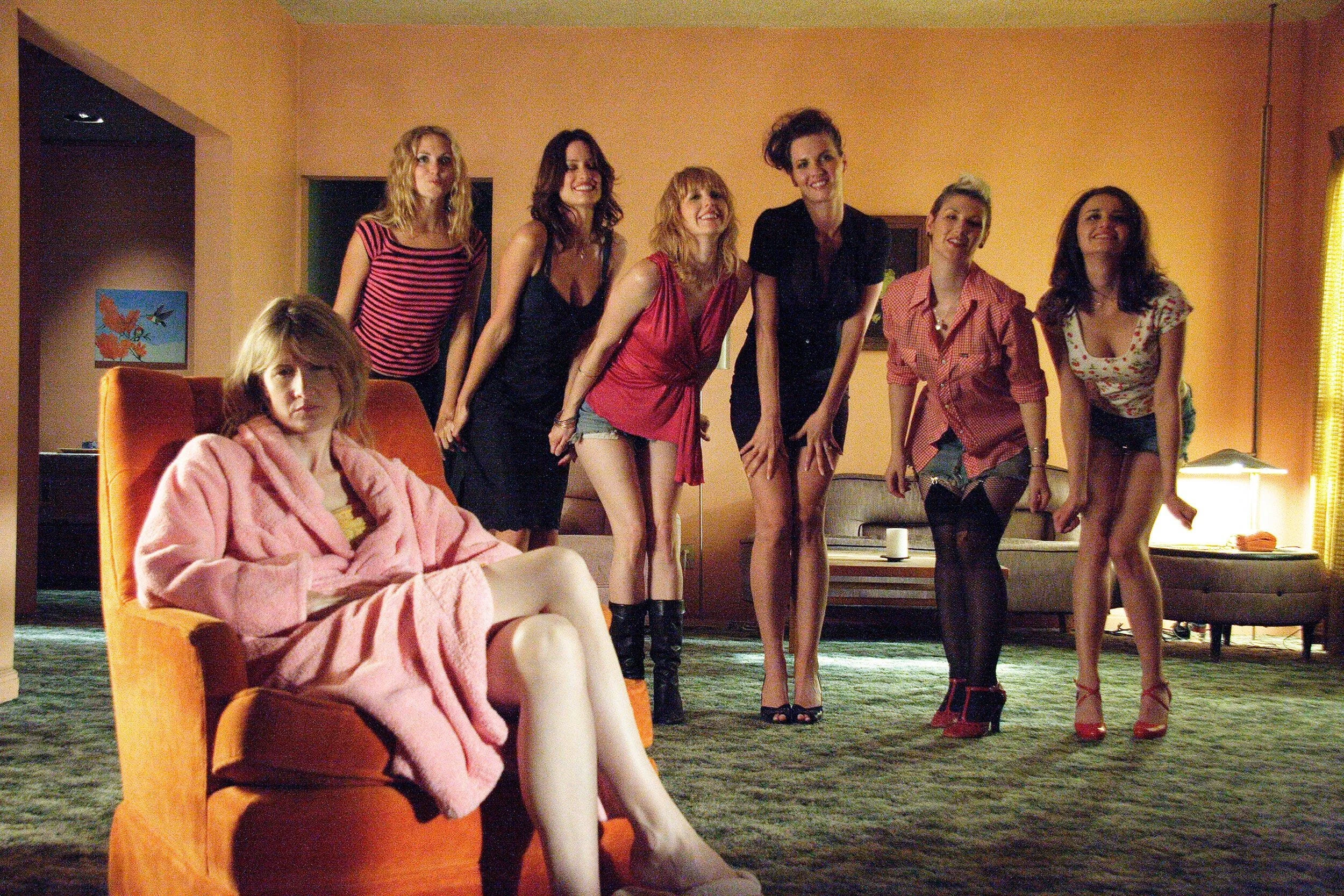
Inland Empire tells the story of Nikki Grace, an actress in Los Angeles who receives the role of Sue Blue in the film ‘On High in Blue Tomorrows’. As the production of that film takes place, Nikki begins to have difficulty differentiating what is real and what is scripted within that film. What comes next is a slurry of different worlds with different characters with occasional moments of linkages – Sue Blue survives her abusive husband Smithy, interacts with a group of prostitutes on Hollywood Boulevard, and confesses her crimes to what seems to be a therapist or policeman. Meanwhile, the prostitutes guide her into Poland where a separate story takes place concerning a woman who also survives an abusive husband and is hypnotized to murder another person. All of this takes place while three rabbit humanoids live their routine - sitting on the couch, taking phone calls, ironing clothes, with occasional disruptions, such as Sue’s phone call causing the phone ringing for the rabbits, or Sue’s burning a hole in a silk which assumably causes the burning of the wall in the Rabbits’ room. And most notably, the old men who asks Piotrek (Nikki’s husband) to assist Nikki are revealed to be the Rabbits in disguise. All of the storylines intertwine in such a way that dissecting the film is similar to navigating a dark maze, which is what makes understanding this film so difficult.
The first step to solve this puzzle of a film is to trace its artistic origins. The birth of Inland Empire is a bizarre experimentation itself as David Lynch shot the film without a completed script or cinematographer. In an interview, David Lynch commented that the making of the film was a risk since he “wrote the thing scene by scene” and “didn’t have much of a clue how it would end” (Atwood). If there must be a definite point where the idea of Inland Empire germinated, it would be David Lynch’s website, davidlynch.com, where he uploaded various short films sometime in the early 2000s. From June of 2002 onwards, David Lynch began uploading a web series by the title Rabbits featuring Naomi Watts, Laura Harring and Scott Cawfey, cast members of Mulholland Drive (Chateau). The series consists of eight episodes, with each episode being a form of corrupted sit-com where the three rabbit-headed humanoids perform mundane tasks while reciting seemingly illogical lines, then being met with ominously long laughter and applause. The idea for Inland Empire slowly spawned after Lynch filmed a scene where Laura Dern recites a 17-page monologue, as mentioned in an interview (I may find citation later). From that point onwards, Lynch would write, direct, shoot, and edit the film, slowly building it into the Inland Empire as we know today. This goes against the traditional process of filmmaking where there are clear distinctions between pre-production, production and post-production, as well as well-defined roles such as director, producer, cinematographer, and editor. This not only means Inland Empire is Lynch’s most uncompromising work since Eraserhead (1977) due to his involvement in every step of the process, but also this is Lynch’s artistic expression when it is unmitigated by any studio or technological limitations. The film was neither adapted from a novel nor planned to be a television series but streamlined into a film , such as Mulholland Drive. With Inland Empire being the most challenging Lynch film, it had generated less discussion than most of Lynch’s other works due to its almost unmarketable nature. And much of it might be due to the film’s use of digital photography.
Part 1: Inland Empire as a Form of Digital Violence
Despite the fact that digital cinema seems to be the dominating norm of our current age, it was a recent invention in the overall scheme of film history. During the 1980s and 1990s, the film industry began transitioning towards digital cinematography with, the newly invented MOS sensor for the camera (Stump). While digital cinematography was still seen as rough and inferior to the more defined and traditional celluloid film, filmmakers experimented with the rough, fuzzy quality of the digital camera by the late ‘90s. While digital cinematography was mainly reserved for home video and independent documentaries such as Hoop Dreams (1994), the late ‘90s and early 2000s saw a rise of the intentional artistic choice of using the digital camera to evoke specific emotions, tell a statement, or create a tone, resulting in films such as Hideaki Anno’s Love & Pop (1998) and Thomas Vinterberg’s The Celebration (1998). In these films, the fuzzy, pixelated quality of the image also evokes the feeling of watching a home video, which creates a strangely intimate and authentic feel. Anno and Iwai use the digital format to evoke youthful nostalgia as many of their shots feel unplanned and unscripted, while Vinterberg leans into the chaotic nature of the handheld digital camera as a machine unhooked from rigs or dolly tracks. In the film In Praise of Love (2001), Godard uses the digital format as a strong contrast against traditional black-and-white celluloid film in order to comment on the way the medium of cinema changes. In any case, filmmakers lean on the flawed look of the digital camera and place themselves along with the tides of technological change in order to create new art that challenges how a film should feel. In a similar vein, David Lynch’s adherence to the digital form in Inland Empire is an artistically intentional choice that evokes the same challenging feeling.
In an interview, David Lynch refers to the photochemical process of celluloid film development as a ‘dinosaur’, and while convenience plays a large role in Lynch’s decision to solely use a digital camera especially with the heavily unplanned nature of the production, the digital form still plays a key role in making Inland Empire the visual monster that it is. First and foremost, the pixelated, color-corrupted digital look of Inland Empire reinforces the feeling that what we see is a home video or a documentary, which adds onto the realism of the film. Clashing that realism against the surreal nature of the narrative is what places the film in an uncanny valley - a sweet spot between real and surreal that produces a disquieting sense of dread. Watching Sue Blue speaking to her husband in their backyard is like witnessing a real piece of lost footage, and with the ominous sound design of each scene such as droning noise, it feels like a corrupted piece of media the viewers are not supposed to see. The uncomfortable close-ups that Lynch applies in this film allow the viewers to view the characters closely and see the skin on their faces pixelated and distorted, directly destabilizing our definition of the corporeal in the digital world.
Beyond that, the digital form of Inland Empire suggests a deeper dimension of the distorted consciousness and thinking in the digital age. With the advancement of digital filmmaking and technology, directors are able to see playback of the shot footage instantly and jump back and forth from the previous take to the next take. Similarly, viewers at home who are enjoying the film on DVD - or in the 2010s, blu-ray - are able to jump from chapter to chapter, rewind, or fast-forward certain scenes. Our ability to destroy linear timelines because of technological advancement is applied onto the content of Inland Empire itself. This way, jumping from Poland to Hollywood to the Rabbits’ Room to the suburbs is akin to jumping from scene to scene or switching from TV channel to another channel. This can be explained as part of the concept of digital modernism which puts into question how our ways of seeing, understanding, structuring and narrating changes due to the digital age (Pressman, 6). When the phrase ‘stream of consciousness’ was coined in the 1880s, it was linked to technologies such as film, wireless tech, or x-ray as means to create inner monologue, thus ‘stream of consciousness’ was not just a literary technique but also a literary technology (Pressman, 118). In this case, a person’s stream of consciousness is mediated by the technologies surrounding the person, like a film camera capturing a person’s movements making the person more conscious of their movements, changing the way they move, which creates a dialogue between the camera and the person. The ‘stream of consciousness’ can also be seen on the internet like a series of Tweets or Instagram posts, which is akin to the way the internet functions during the airing of Rabbits as a part of a stream of ideas. And like a series of footage captured by a digital camera that distorts image and color and disintegrates them into pixels, the characters captured by the camera are forced to undergo that distortion and reacting as such with fear and confusion, and the result of that is to be inevitably plundered into a series of scenes that abandon all logic.
Meanwhile, the viewers helplessly sit and watch as the characters of the film are placed within the harsh distortion of the digital camera both visually and in terms of its distorted effect of narrative. The viewers are subjected to a seemingly never-ending loop of harsh noise, random dance numbers, windy monologues and violent encounters. Coupled with the fact that the film consists of dark imagery of sexual transgression and violence, this film feels like it is made outside of our normal world and as the film plays, it is like the viewers witness the conjuring of evil. In this case, Inland Empire is committing digital violence on both its characters and its viewers.
Part 2: Inland Empire as a Form of Spiritual Transcendence
Inland Empire might also be David Lynch’s most spiritually liberating work. Lynch is no stranger to cynical endings: the ending of Fire Walk with Me is the inevitable death of Laura Palmer which begins Twin Peaks, the end of Lost Highway feeds into the endless loop of violence and confusion and the end of Mulholland Drive remains to be one of the more cynical endings in Lynch’s filmography with Diane committing suicide. On the other hand, Inland Empire surprisingly ends on an empowering note where Nikki Grace defeats the Phantom, rescues The Lost Girl, and is united with multiple characters in a beautiful room where everyone dances and sings along to Nina Simone’s 10-minute soul gospel anthem ‘Sinnerman’.
While David Lynch is well known for his support for transcendental meditation, his spirituality extends further into his films. For example, before the screening of this film, Lynch would sometimes recite the passage, “We are like the spider. We weave our life and then move along in it. We are like the dreamer who dreams and then lives in the dream. This is true for the entire universe,” which is taken from the Hinduist text Mundaka Upanishad (Guillen). If this is not emphasized enough in Lynch’s late works, Monica Belucci also recites a similar mantra in Twin Peaks: The Return. This philosophy can be seen in Inland Empire, not only in terms of the relationship between dreamer and dream showcased by Nikki Grace and her experience becoming her own character, Sue Blue, in Sue’s own story in ‘On High in Blue Tomorrows’, but also in terms of the way the story is interwoven as if it is building upon each other - the storylines build upon each other like a spider web that keeps adding lines connecting different points. The break from reality does not kickstart until roughly one hour into the film, the moment Nikki Grace begins losing her grip onto her own identity. That generates Sue Blue’s story, which then later generates the Polish storylines after the prostitutes teach her how to access that by covering her eyes with her hands and then opening it. The multiple storylines exist because there are multiple ‘dreamers’: Nikki Grace, Sue Blue, the actress in ‘47’ and the Lost Girl, all of whom are the said ‘woman’ in the film’s tagline ‘A Woman in Trouble’.
As Nikki Grace is chosen to play Sue Blue the same way the original actress is chosen to star in the film ‘47’, some online reviews also theorized that Nikki is a reincarnation of that actress, which is why Nikki (as Sue) is fated to be murdered the same way the original actress is murdered during the production of ‘47’. The idea of reincarnations and the endless loops of Inland Empire call towards the idea of ‘samsara’, a Buddhist and Hinduist idea of a never-ending cycle of life and death. The only way in which a person can escape that cycle is to be enlightened and rid themselves of desires. In Inland Empire, Nikki/Sue goes through multiple dimensions and survives multiple acts of violence in order to rediscover her identity and become enlightened. If Nikki’s disobedience to her husband is the cause of her suffering, and the ending of the film sees Nikki breaking free from that curse, ending her suffering and reaching enlightenment would be the ultimate goal (Goodwin, 316). The ending of the film, then, sees Nikki and other characters at the blissful ending of the film, similar to the idea of a ‘Western Pure Land’ which is a Buddhist concept of a paradise for the enlightened ones (Harvey, 163).
The ending of the film is the final act towards reaching transcendence for Nikki, and by extension, the viewers. Near the end of the film when Nikki finds herself in a film in an empty theater, where she as Sue describes her traumatic experiences to the therapist, she is able to reach an understanding that the anguish she faced is one that is interwoven with other stories. She is immersed in an ocean of self-discovery which is created by her unconscious mind, something David Lynch refers to in his book Catching the Big Fish in regard to mediation and creativity (Goodwin, 317). She is transcended spiritually then, which allows her the ability and the courage to shoot the Phantom and rescue the Lost Girl.
In the documentary David Lynch: The Art Life, Lynch describes the ‘supreme enlightenment’ being the only way of getting out of the wheel of life and death – ‘samsara’, and that the only way to reach that is to accumulate kindness because “we are charged by our fellow men”, referring to the concept of ‘karma’. In another video he responds to the death of his friend and composer Angelo Badalamenti, saying that he forever lives, implying that he is reincarnated somewhere else. Through all the reincarnations in Inland Empire, transcendence is finally reached at the very end. Perhaps if we were to subscribe to Lynch’s beliefs, Lynch has not passed away but is reincarnated elsewhere as of this moment. But regardless of what happens, Lynch’s spirits live on in the many films and filmmakers’ hearts for generations to come. And that might be the best legacy he could possibly leave behind.
Works Cited
Attwood, Chris; Roth, Robert. "A Dog's Trip to the Chocolate Shop – David Lynch". Healthy Wealthy N' Wise. September 2005.
Chateau, Jérémy. "Le site davidlynch.com: Le statut de l'artiste à l'ère d'internet". Ligeia (in French). 165168 (2). October 2018.
Goodwin, Jonathan. “The Separate Worlds of David Lynch's Inland Empire.” Quarterly Review of Film and Video. 2014.
Guillen, Michael. "Inland Empire—The San Rafael Film Center Q&A With David Lynch". Twitch Film. 2007.
Harvey, Peter. Introduction to Buddhism: Teachings, History, and Practices. Cambridge University Press. 2012.
Inland Empire. Dir. David Lynch. Absurda. Studio Canal. 2006.
Pressman, Jessica. Digital Modernism: Making It New in New Media. Modernist Literature and Culture. University of Oxford. January 2014.
Stump, David. Digital Cinematography: Fundamentals, Tools, Techniques, and Workflows. Routledge. 2014.
The Reclamation of The Witch: Suspiria (1977) and The Craft (1996)
The move from fearing the witch to the acceptance of the witch between the films Suspiria (Argento, 1977) and The Craft (Fleming, 1996) demonstrates the reclamation of the term and character of the “witch,” and how this repossession coincides with the changes in perspective on feminism and women’s role in society over time.
By Katie Kopff, Edited by Amanda Mayoras and Anne Tilley
The depiction of the witch has been present in folk culture and media for centuries, often reflecting societal fears and tensions occurring in society at the time, particularly regarding feminism. Earlier horror films often reflected negative opinions on the feminist movement, while modern films focus on female empowerment rather than fear, demonstrating the change in societal views. The move from fearing the witch to the acceptance of the witch between the films Suspiria (Argento, 1977) and The Craft (Fleming, 1996) demonstrates the reclamation of the term and character of the “witch,” and how this repossession coincides with the changes in perspective on feminism and women’s role in society over time.
Scholarly conversations on the witch-horror subgenre have discussed how the witch figure can be used as a mirror to reflect society’s anxieties and fears surrounding gender and femininity. As expressed by award-winning author Heather Greene in Lights, Camera, Witchcraft (2021), American film and television have used the witch as the designated figure to embody ever-changing public opinions on women’s autonomy and role in society. Greene further states that early witch depictions followed patriarchal anxieties of female empowerment, in contrast to later representations, asserting, “the witch is never just a witch—she is whatever society currently fears or desires in a woman” (Greene 46). Silvia Bovenschen in “The Contemporary Witch, the Historical Witch and the Witch Myth” (1978), states “women were made into witches to justify their domination,” (Bovenschen 90). Bovenschen explains that the witch has a direct association with societal disruption. During times when women’s rights were still seen as highly controversial, the use of this character allowed the media to subtly convey the fears they had about gender equality, serving as “a projection of men’s fear of female sexuality, knowledge, and independence” (Bovenschen 95). This understanding of the witch archetype is relevant when looking at the 1970s during the era of second-wave feminism, when these new ideologies clashed with women’s role in domestic life.
Author Andrew Scahill spotlights the use of supernatural characters as a way of displaying patriarchal fears in the 1970s horror industry. Scahill describes that films during that time presented, on many occasions, “the female collective as a terrifying coven whose power must be contained” (Scahill 112). Suspiria mirrors the films Scahill is describing that presents women in leadership roles as a threat to society during this era of second-wave feminism. In the film, Suzy’s innocence is in danger due to female power, mirroring Bovenschen’s concept of “the fantasy of the uncontrollable woman” (Bovenschen 92). There was a major shift to this portrayal, however, in the 1990s. In this era, we can see a significant turn towards witches being identified as empowering and individualistic, themes that align with the third-wave feminism of that era. Filmmaker, professor, and author Alison Peirse describes that 1990s media “reimagines the witch as an emblem of individual agency rather than collective threat” (Peirse 27). The popularity and frequency of teen witch films, such as The Craft, utilizes what Erin Collopy identifies as “the witch as a site of identity formation,” (Collopy 53) where powers are used to represent overcoming trauma and gender norms. Additionally, Greene argues a similar point by stating that the 90s marked “the mainstreaming of the witch as a positive or at least sympathetic figure in American culture,” (Greene 287) a shift caused by the new wave of feminism.
This scholarly conversation depicts the shifting views on the witch and how they mirror views on feminist movements. Suspiria (1977) and The Craft (1996) illustrate two of the sharp turning points within the cultural shift. One film represents the earlier second-wave feminism anxieties on women empowerment, and the other represents the later third-wave feminism views on celebrating gender individuality and the breaking down of those societal roles. As stated by Greene, these films represent “a barometer for society’s comfort with female power” (Greene, 48).
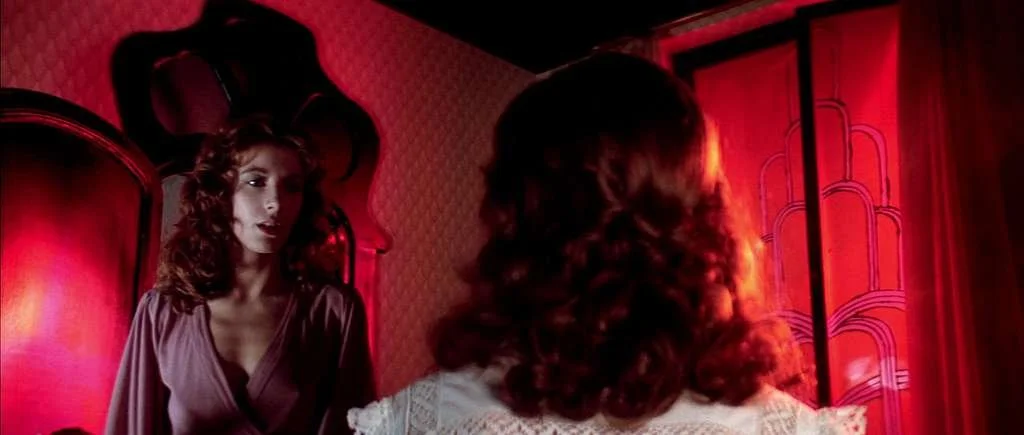
The costuming in Suspiria allows the viewers to develop a deeper understanding of the underlying tensions between each character and what they are made to represent. Our first encounter with our protagonist, Suzy, is when she first arrives in Germany at the airport. She is seen wearing a white flowy dress, perfectly curled hair, and minimal makeup with rosy cheeks, signalling Suzy’s innocence and purity. Furthermore, the costuming of other characters often reveals their true intentions and role in the story prior to it being revealed through the plot. This is demonstrated through the character of Miss Tanner, who is the head instructor at the dance school and a member of the coven. Miss Tanner is constantly seen wearing a black suit. Both the color and clothing choice show the stark contrast between these two characters, while Suzy is meant to represent youth and innocence Miss Tanner is meant to be viewed as old and corrupted.
The use of color in terms of lighting is also significant throughout the film, foreshadowing tension or the fates of characters. The film utilizes colors such as red, green, blue, and purple to represent different intense moments of supernatural activity throughout the film. Red, the most dominant color featured, is mainly used when a character is about to meet their demise to the coven. In the final confrontation between Suzy and the coven, the entirety of the coven’s meeting place was covered in vibrant red lighting as they threatened Suzy’s life. The use of colors such as green, purple, and blue are used to demonstrate the presence of the coven and shows the underlying presence of dark, mysterious figures.
The presence of music and sound throughout the film helps to immerse the audience in the dark and supernatural world of Tanz Dance Academy. The score of Suspiria is composed and performed by an Italian progressive rock band named “Goblin.” By using synthesizers and ambient sounds to captivate the viewers, an eerie and supernatural vibe is created to match the visuals on screen. Additionally, the film utilizes whispers and unstable rhythms to convey to the audience that there is uncertainty and danger throughout the film.
The Craft features various modes of lighting to show the contrast between each character’s personalities, motivations, and emotional states. The main character of the film, Sarah, is constantly illuminated using softer, more natural lighting. This demonstrates Sarah’s pure and moral intentions, particularly with her powers. Compared to the other members of the coven, Bonnie, Nancy, and Rochelle, Sarah has more noble intentions. Greed, in regards to powers, is something shared with the three other members of the coven, which is demonstrated through the lighting contrast between them and Sarah. The other members of the group are shown in dark lighting with cooler undertones, demonstrating their emotional instability and corrupting nature. This contrast grows as the film progresses, as Bonnie, Rochelle, and Nancy descend deeper into the depths of their dark magic. However, Sarah’s lighting remains soft and natural even in scenes where she is with the rest of the coven, showing how she has maintained her moral high ground.
The clothing and color palette of the coven members in The Craft is used as an effective storytelling tool to allow the audience to further understand the personality and motives of each character. There is also a shift in the clothing of the coven members. In the beginning of the film, Bonnie wears oversized clothing, mainly in softer colors, to hide the burn scars that cover her body. This clothing also represents her shy and insecure nature that she exhibits throughout much of the film. Rochelle also wears softer colors initially, in addition to more practical clothing, which is a contrast to what she wears later in the film, demonstrating her character’s desire to conform with the rest of the student body. Nancy differs from the other members as she is seen wearing very dark clothing throughout the entirety of the film. Although she is not yet fully consumed by dark magic, she wants to be, and her clothing choices reflect this. In contrast, Sarah wears light and earthy toned clothing symbolizing her innocence and more grounded connection to her powers. As the coven begins to obsess with the idea of dark magic, their costumes shift to darker colors and more form-fitting clothing to reflect their growing confidence with themselves as their powers grow. The use of accessories and makeup further accentuates this shift, as the girls can be seen wearing dark and dramatic makeup and statement jewelry such as crosses and spikes. After the final battle, Bonnie and Rochelle’s wardrobe returns to soft and practical clothes, reflecting their loss of power and return to normalcy.
The score and sound of The Craft works to captivate the viewers by establishing the tone of the film, helping the audience understand the motivations of the characters, and demonstrating the presence of witchcraft and other supernatural elements. Fleming utilizes sounds such as whispers and chanting to emphasize the ritualistic nature of the coven, displaying to the audience that the intentions of the coven are sinister and exploitative. Additionally, the score of the film offers a similar effect through the use of ambient sounds creating a dark and ethereal tone to every scene. The score is also utilized to demonstrate a moral tension between each of the characters: scenes that are showing Nancy’s abuse of power are accompanied with more eerie and dark instrumentals while scenes with Sarah are often accompanied by more ethereal and airy tones showing restraints and groundedness with her powers. Lastly, the use of needledrops in the film work to place the audience in the time period which the film takes place. The Craft features songs such as “How Soon Is Now?” covered by Love Split Love and “Whole Lotta Love” By Led Zeppelin, among other alternative rock songs.
Both The Craft and Suspiria utilizes various aspects of film to further their storytelling and entrance the audience into the world they’ve created. However, the use of these factors differ based on the message each film is trying to convey. Both are female centered films that discuss the supernatural and feature ritualistic witch figures. Yet, the depiction of these witches varies greatly. In Suspiria, the coven is the antagonist who is attempting to destroy the innocent female characters around them. In contrast, The Craft offers many different portrayals of witches showing that this darkness is not something fundamental to witchcraft itself, but is a choice made by each individual witch. This is shown through contrast in characterization of Nancy and Sarah. Nancy is someone who is seen from the beginning of the film to be power-hungry and obsessed with dark magic, while Sarah simply accepts her natural ability and is strongly against using it to do any harm to others. Although Sarah is a witch, she is shown to be a significantly more nuanced character than the witches shown in Suspiria, which are given little to no character development or backstory. The depiction of witches in Supiria is significantly more one-dimensional compared to the witch characters in The Craft.
Suspiria and The Craft provide a roadmap of the witch horror sub-genre as it evolved to reflect societal attitudes on women and feminism. Second-wave feminism of the 1970s, focused on disrupting society’s role for women, plagued the media with fears of female empowerment. Third-wave feminism of the 1990s focused on celebrating individuality of women and breaking down gender roles, which is mirrored through the characters in The Craft. Through costuming, lighting, and the score, both films depict these witch figures in different ways in order to reflect the societal opinions of the time. This transition demonstrates that cinema, and media as a whole, can be used to influence the viewers, but can also be a direct reflection of societal opinions.
Work Cited
Bovenschen, Silvia, Jeannine Blackwell, Johanna Moore, and Beth Weckmueller. “The Contemporary Witch, the Historical Witch and the Witch Myth.” New German Critique 15 (1978): 83–119. https://doi.org/10.2307/487908.
Collopy, Erin. “Witches, Wardrobes, and Rebellious Girls: Teen Witch Films of the 1990s.” In Children in the Films of the 1990s, edited by Martin Norden, 145–163. New York: Routledge, 2015.
Greene, Heather. Lights, Camera, Witchcraft: A Critical History of Witches in American Film and Television. Woodbury, MN: Llewellyn Worldwide, 2021.
Peirse, Alison. Women Make Horror: Filmmaking, Feminism, Genre. New Brunswick, NJ: Rutgers University Press, 2020.
Scahill, Andrew. “Witches and the Anxiety of Female Power.” In Bell, Book and Camera: A Critical History of Witches in American Film and Television, edited by Heather Greene, 149–170. Jefferson, NC: McFarland, 2018.