
The Reclamation of The Witch: Suspiria (1977) and The Craft (1996)
The move from fearing the witch to the acceptance of the witch between the films Suspiria (Argento, 1977) and The Craft (Fleming, 1996) demonstrates the reclamation of the term and character of the “witch,” and how this repossession coincides with the changes in perspective on feminism and women’s role in society over time.
By Katie Kopff, Edited by Amanda Mayoras and Anne Tilley
The depiction of the witch has been present in folk culture and media for centuries, often reflecting societal fears and tensions occurring in society at the time, particularly regarding feminism. Earlier horror films often reflected negative opinions on the feminist movement, while modern films focus on female empowerment rather than fear, demonstrating the change in societal views. The move from fearing the witch to the acceptance of the witch between the films Suspiria (Argento, 1977) and The Craft (Fleming, 1996) demonstrates the reclamation of the term and character of the “witch,” and how this repossession coincides with the changes in perspective on feminism and women’s role in society over time.
Scholarly conversations on the witch-horror subgenre have discussed how the witch figure can be used as a mirror to reflect society’s anxieties and fears surrounding gender and femininity. As expressed by award-winning author Heather Greene in Lights, Camera, Witchcraft (2021), American film and television have used the witch as the designated figure to embody ever-changing public opinions on women’s autonomy and role in society. Greene further states that early witch depictions followed patriarchal anxieties of female empowerment, in contrast to later representations, asserting, “the witch is never just a witch—she is whatever society currently fears or desires in a woman” (Greene 46). Silvia Bovenschen in “The Contemporary Witch, the Historical Witch and the Witch Myth” (1978), states “women were made into witches to justify their domination,” (Bovenschen 90). Bovenschen explains that the witch has a direct association with societal disruption. During times when women’s rights were still seen as highly controversial, the use of this character allowed the media to subtly convey the fears they had about gender equality, serving as “a projection of men’s fear of female sexuality, knowledge, and independence” (Bovenschen 95). This understanding of the witch archetype is relevant when looking at the 1970s during the era of second-wave feminism, when these new ideologies clashed with women’s role in domestic life.
Author Andrew Scahill spotlights the use of supernatural characters as a way of displaying patriarchal fears in the 1970s horror industry. Scahill describes that films during that time presented, on many occasions, “the female collective as a terrifying coven whose power must be contained” (Scahill 112). Suspiria mirrors the films Scahill is describing that presents women in leadership roles as a threat to society during this era of second-wave feminism. In the film, Suzy’s innocence is in danger due to female power, mirroring Bovenschen’s concept of “the fantasy of the uncontrollable woman” (Bovenschen 92). There was a major shift to this portrayal, however, in the 1990s. In this era, we can see a significant turn towards witches being identified as empowering and individualistic, themes that align with the third-wave feminism of that era. Filmmaker, professor, and author Alison Peirse describes that 1990s media “reimagines the witch as an emblem of individual agency rather than collective threat” (Peirse 27). The popularity and frequency of teen witch films, such as The Craft, utilizes what Erin Collopy identifies as “the witch as a site of identity formation,” (Collopy 53) where powers are used to represent overcoming trauma and gender norms. Additionally, Greene argues a similar point by stating that the 90s marked “the mainstreaming of the witch as a positive or at least sympathetic figure in American culture,” (Greene 287) a shift caused by the new wave of feminism.
This scholarly conversation depicts the shifting views on the witch and how they mirror views on feminist movements. Suspiria (1977) and The Craft (1996) illustrate two of the sharp turning points within the cultural shift. One film represents the earlier second-wave feminism anxieties on women empowerment, and the other represents the later third-wave feminism views on celebrating gender individuality and the breaking down of those societal roles. As stated by Greene, these films represent “a barometer for society’s comfort with female power” (Greene, 48).
The costuming in Suspiria allows the viewers to develop a deeper understanding of the underlying tensions between each character and what they are made to represent. Our first encounter with our protagonist, Suzy, is when she first arrives in Germany at the airport. She is seen wearing a white flowy dress, perfectly curled hair, and minimal makeup with rosy cheeks, signalling Suzy’s innocence and purity. Furthermore, the costuming of other characters often reveals their true intentions and role in the story prior to it being revealed through the plot. This is demonstrated through the character of Miss Tanner, who is the head instructor at the dance school and a member of the coven. Miss Tanner is constantly seen wearing a black suit. Both the color and clothing choice show the stark contrast between these two characters, while Suzy is meant to represent youth and innocence Miss Tanner is meant to be viewed as old and corrupted.
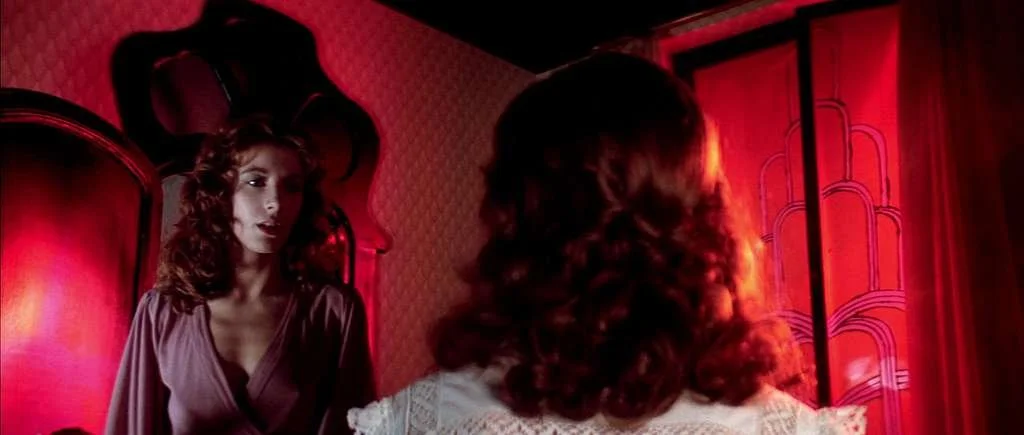
The use of color in terms of lighting is also significant throughout the film, foreshadowing tension or the fates of characters. The film utilizes colors such as red, green, blue, and purple to represent different intense moments of supernatural activity throughout the film. Red, the most dominant color featured, is mainly used when a character is about to meet their demise to the coven. In the final confrontation between Suzy and the coven, the entirety of the coven’s meeting place was covered in vibrant red lighting as they threatened Suzy’s life. The use of colors such as green, purple, and blue are used to demonstrate the presence of the coven and shows the underlying presence of dark, mysterious figures.
The presence of music and sound throughout the film helps to immerse the audience in the dark and supernatural world of Tanz Dance Academy. The score of Suspiria is composed and performed by an Italian progressive rock band named “Goblin.” By using synthesizers and ambient sounds to captivate the viewers, an eerie and supernatural vibe is created to match the visuals on screen. Additionally, the film utilizes whispers and unstable rhythms to convey to the audience that there is uncertainty and danger throughout the film.
The Craft features various modes of lighting to show the contrast between each character’s personalities, motivations, and emotional states. The main character of the film, Sarah, is constantly illuminated using softer, more natural lighting. This demonstrates Sarah’s pure and moral intentions, particularly with her powers. Compared to the other members of the coven, Bonnie, Nancy, and Rochelle, Sarah has more noble intentions. Greed, in regards to powers, is something shared with the three other members of the coven, which is demonstrated through the lighting contrast between them and Sarah. The other members of the group are shown in dark lighting with cooler undertones, demonstrating their emotional instability and corrupting nature. This contrast grows as the film progresses, as Bonnie, Rochelle, and Nancy descend deeper into the depths of their dark magic. However, Sarah’s lighting remains soft and natural even in scenes where she is with the rest of the coven, showing how she has maintained her moral high ground.
The clothing and color palette of the coven members in The Craft is used as an effective storytelling tool to allow the audience to further understand the personality and motives of each character. There is also a shift in the clothing of the coven members. In the beginning of the film, Bonnie wears oversized clothing, mainly in softer colors, to hide the burn scars that cover her body. This clothing also represents her shy and insecure nature that she exhibits throughout much of the film. Rochelle also wears softer colors initially, in addition to more practical clothing, which is a contrast to what she wears later in the film, demonstrating her character’s desire to conform with the rest of the student body. Nancy differs from the other members as she is seen wearing very dark clothing throughout the entirety of the film. Although she is not yet fully consumed by dark magic, she wants to be, and her clothing choices reflect this. In contrast, Sarah wears light and earthy toned clothing symbolizing her innocence and more grounded connection to her powers. As the coven begins to obsess with the idea of dark magic, their costumes shift to darker colors and more form-fitting clothing to reflect their growing confidence with themselves as their powers grow. The use of accessories and makeup further accentuates this shift, as the girls can be seen wearing dark and dramatic makeup and statement jewelry such as crosses and spikes. After the final battle, Bonnie and Rochelle’s wardrobe returns to soft and practical clothes, reflecting their loss of power and return to normalcy.
The score and sound of The Craft works to captivate the viewers by establishing the tone of the film, helping the audience understand the motivations of the characters, and demonstrating the presence of witchcraft and other supernatural elements. Fleming utilizes sounds such as whispers and chanting to emphasize the ritualistic nature of the coven, displaying to the audience that the intentions of the coven are sinister and exploitative. Additionally, the score of the film offers a similar effect through the use of ambient sounds creating a dark and ethereal tone to every scene. The score is also utilized to demonstrate a moral tension between each of the characters: scenes that are showing Nancy’s abuse of power are accompanied with more eerie and dark instrumentals while scenes with Sarah are often accompanied by more ethereal and airy tones showing restraints and groundedness with her powers. Lastly, the use of needledrops in the film work to place the audience in the time period which the film takes place. The Craft features songs such as “How Soon Is Now?” covered by Love Split Love and “Whole Lotta Love” By Led Zeppelin, among other alternative rock songs.
Both The Craft and Suspiria utilizes various aspects of film to further their storytelling and entrance the audience into the world they’ve created. However, the use of these factors differ based on the message each film is trying to convey. Both are female centered films that discuss the supernatural and feature ritualistic witch figures. Yet, the depiction of these witches varies greatly. In Suspiria, the coven is the antagonist who is attempting to destroy the innocent female characters around them. In contrast, The Craft offers many different portrayals of witches showing that this darkness is not something fundamental to witchcraft itself, but is a choice made by each individual witch. This is shown through contrast in characterization of Nancy and Sarah. Nancy is someone who is seen from the beginning of the film to be power-hungry and obsessed with dark magic, while Sarah simply accepts her natural ability and is strongly against using it to do any harm to others. Although Sarah is a witch, she is shown to be a significantly more nuanced character than the witches shown in Suspiria, which are given little to no character development or backstory. The depiction of witches in Supiria is significantly more one-dimensional compared to the witch characters in The Craft.
Suspiria and The Craft provide a roadmap of the witch horror sub-genre as it evolved to reflect societal attitudes on women and feminism. Second-wave feminism of the 1970s, focused on disrupting society’s role for women, plagued the media with fears of female empowerment. Third-wave feminism of the 1990s focused on celebrating individuality of women and breaking down gender roles, which is mirrored through the characters in The Craft. Through costuming, lighting, and the score, both films depict these witch figures in different ways in order to reflect the societal opinions of the time. This transition demonstrates that cinema, and media as a whole, can be used to influence the viewers, but can also be a direct reflection of societal opinions.
Work Cited
Bovenschen, Silvia, Jeannine Blackwell, Johanna Moore, and Beth Weckmueller. “The Contemporary Witch, the Historical Witch and the Witch Myth.” New German Critique 15 (1978): 83–119. https://doi.org/10.2307/487908.
Collopy, Erin. “Witches, Wardrobes, and Rebellious Girls: Teen Witch Films of the 1990s.” In Children in the Films of the 1990s, edited by Martin Norden, 145–163. New York: Routledge, 2015.
Greene, Heather. Lights, Camera, Witchcraft: A Critical History of Witches in American Film and Television. Woodbury, MN: Llewellyn Worldwide, 2021.
Peirse, Alison. Women Make Horror: Filmmaking, Feminism, Genre. New Brunswick, NJ: Rutgers University Press, 2020.
Scahill, Andrew. “Witches and the Anxiety of Female Power.” In Bell, Book and Camera: A Critical History of Witches in American Film and Television, edited by Heather Greene, 149–170. Jefferson, NC: McFarland, 2018.