
Gothic Decoding: Hall, Halberstam, and Hitchcock’s Rebecca
"Monsters in media so often offer us that escape from societal constraints, representing that which repulses the hetero-patriarchal system we live in—the different, the scorned, the uncanny, the queer. "
By Lulu Foyle, Edited by Ella Kilbourne
When I was a little girl, I was obsessed with werewolves. The idea of transformation was intoxicating to me, the shift into a non human space, a non-gendered form, the freedom that would come with a new body. It would take years to realize that I was not, in fact, a little girl; that the fascination with transformation narratives came from a desire to leave behind my own gendered form and all the restrictions that came with it. Monsters in media so often offer us that escape from societal constraints, representing that which repulses the hetero-patriarchal system we live in—the different, the scorned, the uncanny, the queer. Alfred Hitchcock’s 1940 gothic romance Rebecca occupies itself with those very same hetero-patriarchal systems of gender and sexuality, endeavouring to show audiences exactly what happens when such systems are disrupted. Rebecca is encoded with anxieties about the breakdown of patriarchal gender norms, exemplified in both the monstrous queer status of Rebecca and Mrs. Danvers as well as the policing of the unnamed protagonist’s gender expression. When decoding the film through a postmodern gothic lens, societal perception of the feminine ideal is pleasurably and vindictively deconstructed by Rebecca’s monstrous queer women, ultimately alluding to the fallibility of heterosexist societal and gender norms.
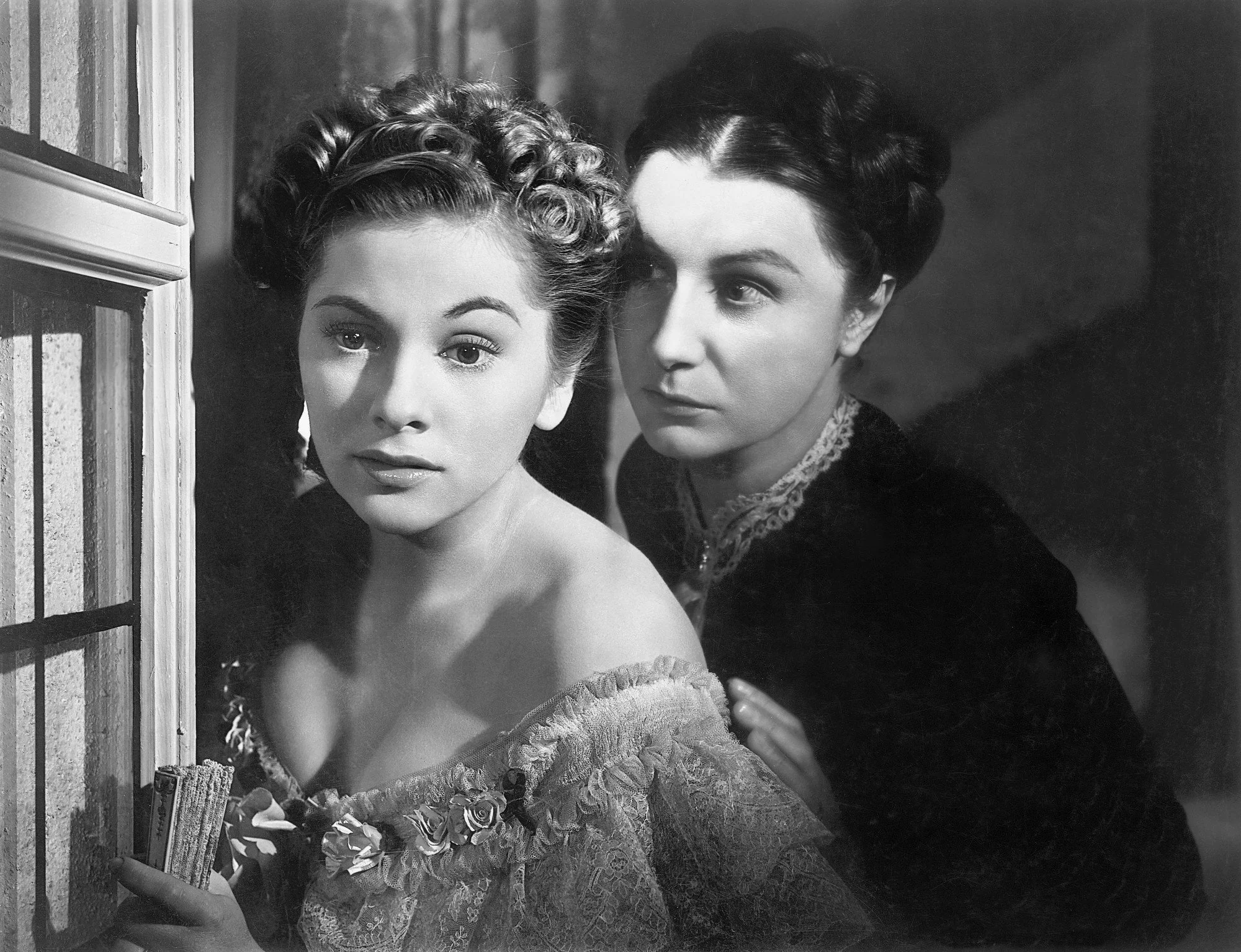
Rebecca follows a young, unnamed woman (Joan Fontaine) through her courtship and marriage with mysterious widower Maxim de Winter (Laurence Olivier). The protagonist struggles to adjust to married life with Maxim, plagued by the memory of the late Rebecca de Winter and harried by Mrs. Danvers (Judith Anderson), the unsettling head housekeeper. Produced firmly under the law of the Motion Picture Production Code, Rebecca is a gothic romance fighting to retain its gothic side. The taboo, the unsettling, and the queer find their home in gothic literature, and the queer theming of Rebecca—found in Mrs. Danvers’ relationship with the titular character—had to be discreetly conveyed (Berenstein). Using Stuart Hall’s theories of encoding and decoding, one can examine the ideas that make up the text in contrast with the ideas that might be received upon viewing. Hall posits that the creator(s) of any piece of media draw from every aspect of the “wider socio-cultural and political structure of which they are a… part” (53) when creating, and such ideas become inextricably woven into the fabric of the work. It is through this lens that one may examine Rebecca’s portrayal of female sexuality, autonomy, and gender presentation in relation to the environment in which it was made.
Rebecca, at its core, is a film about gender roles. Encoded in its portrayal of its female characters are the hetero-partriarchal ideals of how a woman must exist—ultimately punishing any female character who dares deviate. Through Maxim’s keen eye, the narrative closely monitors the developing gender performance of its protagonist, trotting out example after example of women who have failed to measure up to the demands of femininity before her. All of these women, in turn, become the enforcers of her femininity. Though they, themselves, have been failed by the volatile rules of gender presentation, they impose the same oppression onto the protagonist, measuring success as the winning of male affection—which, in this case, comes primarily from Maxim.
The first keeper of the protagonist’s femininity is Ms. Van Hopper (Florence Bates), the protagonist’s employer: She is a socialite well past her prime, a woman too old and too boorish to deserve Maxim’s notice. She belittles the protagonist at nearly every opportunity, heavily critiquing the few choices the protagonist does make, and, after learning of the protagonist and Maxim’s engagement, taunting her with her inability to live up to Rebecca. Ms. Van Hopper’s leash on the protagonist is then handed over to two more guards of her gender presentation: Maxim (with his brusque commands and infatuation with the protagonist’s youth) and his sister Beatrice (Gladys Cooper). Beatrice, similar to Ms. Van Hopper, is an aging, rude woman, though her age and attitude are minor offences when placed against her most egregious fault—her marriage, in which she is dominant and unfeeling. Much like Ms. Van Hopper, Beatrice is faulted for her independence, her refusal to be subservient to a man. The resulting narrative punishment for the two of them is general unhappiness—Ms. Van Hopper in her loneliness, Beatrice in her unhappy marriage. She is overbearing in every interaction, fondly lauding the late Rebecca, callously picking apart the protagonist’s appearance: “I can see by the way you dress, you don’t give a hoot how you look” (Rebecca 0:45:17). These two women delight in the policing of the protagonist’s gender presentation, eagerly turning the criterion used against themselves onto a younger, more vulnerable target. This makes them unpleasant, minor antagonists in the eyes of the narrative, but it does not make them monstrous.
The monstrosity of gender nonconformity is reserved for one character in particular: Mrs. Danvers. Mrs. Danvers (sometimes referred to, androgynously, as “Danny”) is the visual foil to the protagonist’s gendered appearance. Tall and rigid where the protagonist is small and malleable, her dark, closely pinned hair contrasting sharply with the protagonist’s blonde curls. She seems to transcend the gendered body altogether, appearing in the black uniform of the male servants, drifting eerily through the mansion like something not quite human. In true gothic fashion, Mrs. Danvers transcends categories—blurring the line between male and female, friend and lover, living and dead (Halberstam). She is mocked for her appearance (“She’s not exactly an oil painting, is she?” (Rebecca, 0:42:55)) and yet she turns the same impossible standards of feminine presentation onto the protagonist as Beatrice and Ms. Van Hopper. The gendered ideal that is embodied in the memory of Rebecca is once again held over the protagonist’s head, though Mrs. Danvers’ infatuation with Rebecca is one borne out of love and affection, rather than mere social respect. It is this queer identity that makes Mrs. Danvers monstrous—her devotion to Rebecca leading her beyond the boundaries of life and humanity—and it is this monstrosity that poses a threat to the protagonist.
This film is encoded with a male anxiety of women refusing to fall into their subservient patriarchal gender roles. Mrs. Danvers takes that anxiety and turns it to pure fear: through her rejection of heterosexuality, she grows from undesirable to monstrous. This gendered anxiety is compounded with the queerphobic anxiety so often represented in horror. As Harry M. Benshoff explores in his book, Monsters in the Closet: Homosexuality and the Horror Film, the horror villain is a queer outsider to a heterosexist norm, embodying the anxieties of a hetero-patriarchal society. The threat may be a monstrosity, a perversion, that is man-made, like Frankenstein, or primal, like the Wolfman. Often, it is a monstrosity that spreads. This is the most horrifying concept to heterosexual society: a seeping threat lurking under the surface (Benshoff). The monstrous Mrs. Danvers is encoded with this fear, her presence and influence on the protagonist’s life a threat to the heterosexual ideal of her and Maxim’s marriage. By the end of the film, the threat is eliminated and the protagonist and Maxim are safely away from Mrs. Danvers’ influence, heterosexuality unscathed. The gothic genre explores the taboo, the monstrous, the queer, but it must always venture back from that expedition.
I would like to propose a modern decoding of this film, particularly in relation to these themes of queerness and monstrosity. In his book Skin Shows: Gothic Horror and the Technology of Monsters, Jack Halberstam examines the archetypal gothic monsters (Frankenstein, Dracula, Jekyll/Hyde, etc.) in relation to the queercoding of the gothic genre. He nominates Jonathan Demme’s Silence of the Lambs as the ultimate postmodern gothic story, describing it as a film that has “cannibalized nineteenth-century Gothic, eaten its monsters alive and thrown them up onto the screen” (Halberstam 177). I would propose Rebecca as a similar postmodern gothic tale, almost prototypical to Halberstam’s interpretation of Silence of the Lambs. Uniquely situated as a film adapted from a work of pure gothic literature (Daphne du Maurier’s Rebecca published in 1938), yet produced by a subversive director with an incredible knowledge of the genre, Rebecca bridges the gap between gothic tradition and Halberstam’s postmodern gothic cinema by reflecting those "cannibalized" gothic monsters back onto the genre itself. Here, the main three women in Rebecca (the protagonist, Mrs. Danvers, and Rebecca herself) embody a symbolic generic space in their film, representing the gothic queer figures of Dracula and Frankenstein’s monster.
Though common interpretation of Rebecca’s character positions her as a ghostly figure (Berenstein), her tangible influence upon the other two women could not be more keenly felt, even from beyond the grave. It is revealed in the final act of the film that Rebecca, according to Maxim, was “incapable of love, or tenderness, or decency” (Rebecca 1:32:13), and that her perfect marriage to Maxim had been an illusion. This provides a satisfying twist to the ideal of femininity that Rebecca has represented the entire film—not only was the embodiment of gendered beauty standards a performance all along, it never existed in the first place. It’s an unreachable goal, an unrealistic expectation that every woman is doomed to fall short of, even Rebecca herself. The revelation of Rebecca’s true nature positions her, too, as a queer character, joining Mrs. Danvers in her monstrosity. With Rebecca and Mrs. Danvers positioned as monstrously queer within the narrative, where does that leave the protagonist?
“Gothic… marks a peculiarly modern obsession with boundaries and their collapse,” Halberstam asserts (23). Rebecca’s narrative insists upon exploring the blurring boundaries of the self that our protagonist faces. Her identity is elusive, constantly being dictated by those around her. At dinner with Beatrice and her husband, the protagonist is interrogated about her hobbies, never once stating her own interests, never defining herself. Adrift in her new responsibilities as Maxim’s wife, she follows in the footsteps of Rebecca, echoing her routines, her clothing, even her food preferences (often at the suggestion of Mrs. Danvers). Her first moment of self-definition, in fact, arises in response to Mrs. Danvers’ constant referral to Rebecca as “Mrs. de Winter”—to which the protagonist coldly proclaims “I am Mrs. de Winter now.” (Rebecca 1:14:16). By repeatedly blurring the boundaries between the identities of the protagonist and Rebecca, the queer monstrosity of Rebecca can subsequently be transferred onto the protagonist as well. The policing of her gender expression echoes the way heterosexual norms police the gender expression of all “straight” women, refusing to tolerate any hint at deviation. The influence, then, that Mrs. Danvers and Rebecca both have on the protagonist’s gender presentation can be read as the consummation of their unspoken threat: a monstrosity that spreads.
The threat of an infectious monstrosity is one that can most commonly be ascribed to the vampiric. Rebecca, undead as she is, functions as a Dracula figure—a high profile, high society parasite, hiding in plain sight, doing unspeakable things in the dark, “creating” more like her. In this decoding, she “created” Mrs. Danvers. Mrs. Danvers is subservient to Rebecca, her devoted disciple, following her everywhere, even to the grave. Mrs. Danvers too, is a Dracula figure in the same way that Rebecca is, though her attempt to “turn” the protagonist is ultimately thwarted. Here, the gothic monster allusions become mixed. Mrs. Danvers’ feelings towards the protagonist blur the lines of hate and love—she despises her for daring to take Rebecca’s place, yet pushes her ever closer towards the ghost of Rebecca that threatens to subsume her. This is seen most clearly when Mrs. Danvers pushes the protagonist to attend a ball in the same costume Rebecca once wore. This serves dual functions: a projection of her desire onto the protagonist, dressing her in the costume of the object of her affections, while simultaneously proving the inadequacy of the protagonist as a substitute for Rebecca herself. She finds pleasure in the ways the protagonist can mimic Rebecca, as well as finding a vindictive satisfaction in all the ways she cannot measure up. This is Mrs. Danvers’ vampiric attempt to “turn” the protagonist, yes, but it is also the protagonist’s realization as Frankenstein’s monster. Though almost every character in this film can be credited as one of the protagonist’s “creators” (individuals who influence the shaping of her persona, critique her gender performance, tell her who she is and who she ought to be), this sequence cements Mrs. Danvers as the Dr. Frankenstein to the protagonist’s monster, a selfish creator who builds her out of others’ images, then rejects her once she has been brought to life.
The encoded message in the finale of the film implies the passing of the threat, the ensured safety of hetero-patriarchal society now that Mrs. Danvers and Rebecca have been eliminated. The ideal heterosexual pair have emerged, unscathed, from the lion’s den of queer monstrosity. However, in this decoded reading, perhaps the heterosexual pair have not emerged unscathed, with the protagonist changed as she is. Perhaps those hetero-patriarchal systems that have hung over the entire narrative are not immovable, not innate, and the monstrous queers have succeeded in their escape of the gendered, heterosexual form. Perhaps, for those viewers similarly ostracized from a heterosexist society, there is pleasure in the disruption of those norms. Halberstam posits that “monsters are meaning machines” (21). They offer us escape from societal constraints. I found relief, when I was young, in my depictions of monsters who managed to escape gendered forms; maybe for others, in 20254 or 1940, there is relief to be found in this depiction of the same thing.
Works Cited
Benshoff, Harry M. Monsters in the Closet: Homosexuality and the Horror Film. Manchester, Manchester Univ. Press, 1998.
Berenstein, Rhona J. “Adaptation, Censorship, and Audiences of Questionable Type: Lesbian Sightings in ‘Rebecca’ (1940) and ‘The Uninvited’ (1944).” Cinema Journal, vol. 37, no. 3, 1998, p. 16. JSTOR, www-jstor-org.libproxy1.usc.edu/stable/1225825, https://doi.org/10.2307/1225825.
Halberstam, Jack. Skin Shows: Gothic Horror and the Technology of Monsters. Durham, Duke University Press, 1995.
Hall, Stuart. “Encoding and Decoding in the Television Discourse.” Essential Essays, Volume 1: Foundations of Cultural Studies, vol. 1, 1973, pp. 257–276, https://doi.org/10.1515/9781478002413-014.
Rebecca. Directed by Alfred Hitchcock, United Artists, 12 Apr. 1940.
Rigby, Mair. “Uncanny Recognition: Queer Theory’s Debt to the Gothic.” Gothic Studies, vol. 11, no. 1, May 2009, pp. 46–57, https://doi.org/10.7227/gs.11.1.6.
Wegner, Gesine. “Madly in Love: The Mental Threat of Homosexuality in Hitchcock’s Rebecca (1940).” BRILL EBooks, 1 Jan. 2015, pp. 79–88, https://doi.org/10.1163/9781848883437_009.