
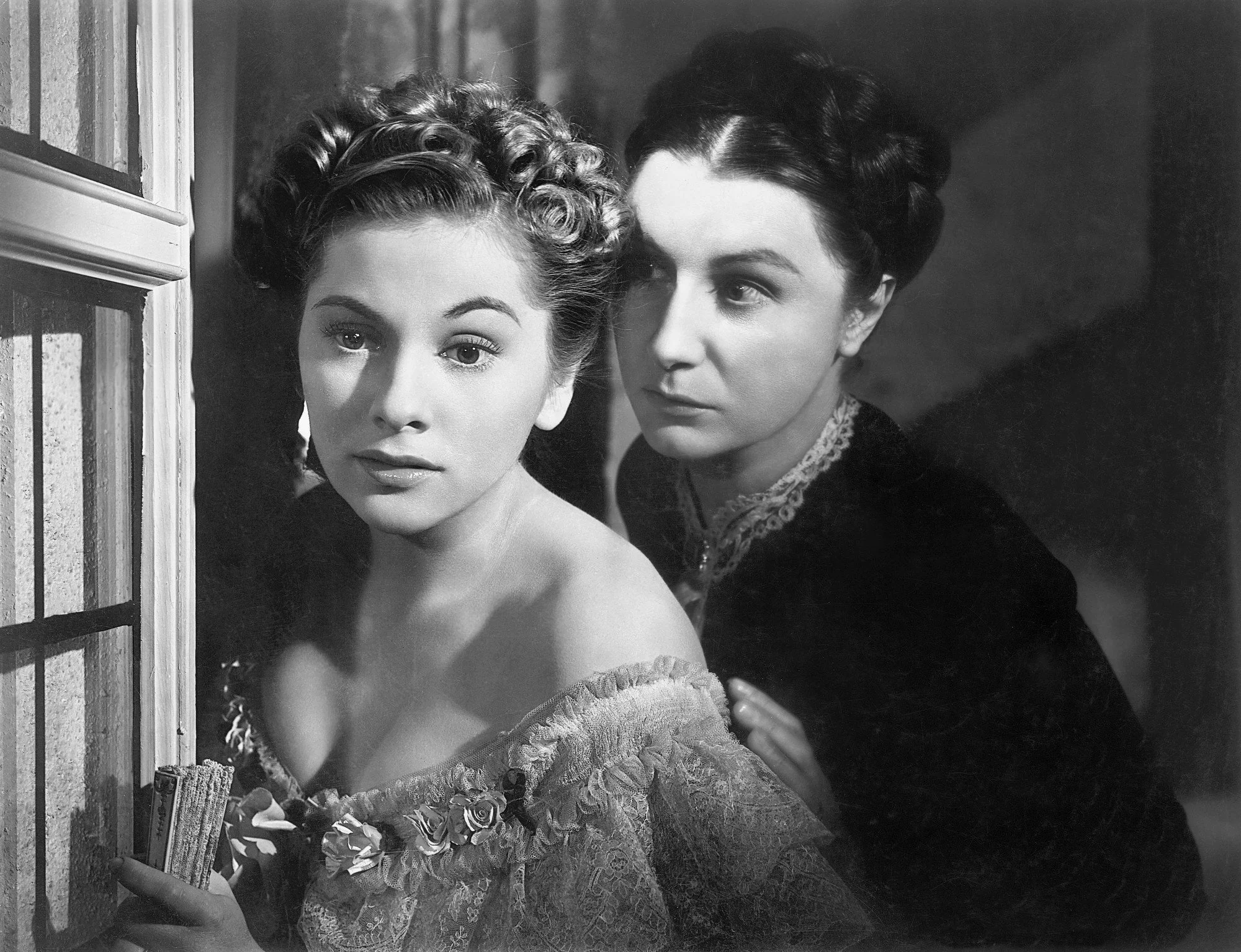
Gothic Decoding: Hall, Halberstam, and Hitchcock’s Rebecca
"Monsters in media so often offer us that escape from societal constraints, representing that which repulses the hetero-patriarchal system we live in—the different, the scorned, the uncanny, the queer. "
By Lulu Foyle, Edited by Ella Kilbourne
When I was a little girl, I was obsessed with werewolves. The idea of transformation was intoxicating to me, the shift into a non human space, a non-gendered form, the freedom that would come with a new body. It would take years to realize that I was not, in fact, a little girl; that the fascination with transformation narratives came from a desire to leave behind my own gendered form and all the restrictions that came with it. Monsters in media so often offer us that escape from societal constraints, representing that which repulses the hetero-patriarchal system we live in—the different, the scorned, the uncanny, the queer. Alfred Hitchcock’s 1940 gothic romance Rebecca occupies itself with those very same hetero-patriarchal systems of gender and sexuality, endeavouring to show audiences exactly what happens when such systems are disrupted. Rebecca is encoded with anxieties about the breakdown of patriarchal gender norms, exemplified in both the monstrous queer status of Rebecca and Mrs. Danvers as well as the policing of the unnamed protagonist’s gender expression. When decoding the film through a postmodern gothic lens, societal perception of the feminine ideal is pleasurably and vindictively deconstructed by Rebecca’s monstrous queer women, ultimately alluding to the fallibility of heterosexist societal and gender norms.
Rebecca follows a young, unnamed woman (Joan Fontaine) through her courtship and marriage with mysterious widower Maxim de Winter (Laurence Olivier). The protagonist struggles to adjust to married life with Maxim, plagued by the memory of the late Rebecca de Winter and harried by Mrs. Danvers (Judith Anderson), the unsettling head housekeeper. Produced firmly under the law of the Motion Picture Production Code, Rebecca is a gothic romance fighting to retain its gothic side. The taboo, the unsettling, and the queer find their home in gothic literature, and the queer theming of Rebecca—found in Mrs. Danvers’ relationship with the titular character—had to be discreetly conveyed (Berenstein). Using Stuart Hall’s theories of encoding and decoding, one can examine the ideas that make up the text in contrast with the ideas that might be received upon viewing. Hall posits that the creator(s) of any piece of media draw from every aspect of the “wider socio-cultural and political structure of which they are a… part” (53) when creating, and such ideas become inextricably woven into the fabric of the work. It is through this lens that one may examine Rebecca’s portrayal of female sexuality, autonomy, and gender presentation in relation to the environment in which it was made.
Rebecca, at its core, is a film about gender roles. Encoded in its portrayal of its female characters are the hetero-partriarchal ideals of how a woman must exist—ultimately punishing any female character who dares deviate. Through Maxim’s keen eye, the narrative closely monitors the developing gender performance of its protagonist, trotting out example after example of women who have failed to measure up to the demands of femininity before her. All of these women, in turn, become the enforcers of her femininity. Though they, themselves, have been failed by the volatile rules of gender presentation, they impose the same oppression onto the protagonist, measuring success as the winning of male affection—which, in this case, comes primarily from Maxim.
The first keeper of the protagonist’s femininity is Ms. Van Hopper (Florence Bates), the protagonist’s employer: She is a socialite well past her prime, a woman too old and too boorish to deserve Maxim’s notice. She belittles the protagonist at nearly every opportunity, heavily critiquing the few choices the protagonist does make, and, after learning of the protagonist and Maxim’s engagement, taunting her with her inability to live up to Rebecca. Ms. Van Hopper’s leash on the protagonist is then handed over to two more guards of her gender presentation: Maxim (with his brusque commands and infatuation with the protagonist’s youth) and his sister Beatrice (Gladys Cooper). Beatrice, similar to Ms. Van Hopper, is an aging, rude woman, though her age and attitude are minor offences when placed against her most egregious fault—her marriage, in which she is dominant and unfeeling. Much like Ms. Van Hopper, Beatrice is faulted for her independence, her refusal to be subservient to a man. The resulting narrative punishment for the two of them is general unhappiness—Ms. Van Hopper in her loneliness, Beatrice in her unhappy marriage. She is overbearing in every interaction, fondly lauding the late Rebecca, callously picking apart the protagonist’s appearance: “I can see by the way you dress, you don’t give a hoot how you look” (Rebecca 0:45:17). These two women delight in the policing of the protagonist’s gender presentation, eagerly turning the criterion used against themselves onto a younger, more vulnerable target. This makes them unpleasant, minor antagonists in the eyes of the narrative, but it does not make them monstrous.
The monstrosity of gender nonconformity is reserved for one character in particular: Mrs. Danvers. Mrs. Danvers (sometimes referred to, androgynously, as “Danny”) is the visual foil to the protagonist’s gendered appearance. Tall and rigid where the protagonist is small and malleable, her dark, closely pinned hair contrasting sharply with the protagonist’s blonde curls. She seems to transcend the gendered body altogether, appearing in the black uniform of the male servants, drifting eerily through the mansion like something not quite human. In true gothic fashion, Mrs. Danvers transcends categories—blurring the line between male and female, friend and lover, living and dead (Halberstam). She is mocked for her appearance (“She’s not exactly an oil painting, is she?” (Rebecca, 0:42:55)) and yet she turns the same impossible standards of feminine presentation onto the protagonist as Beatrice and Ms. Van Hopper. The gendered ideal that is embodied in the memory of Rebecca is once again held over the protagonist’s head, though Mrs. Danvers’ infatuation with Rebecca is one borne out of love and affection, rather than mere social respect. It is this queer identity that makes Mrs. Danvers monstrous—her devotion to Rebecca leading her beyond the boundaries of life and humanity—and it is this monstrosity that poses a threat to the protagonist.
This film is encoded with a male anxiety of women refusing to fall into their subservient patriarchal gender roles. Mrs. Danvers takes that anxiety and turns it to pure fear: through her rejection of heterosexuality, she grows from undesirable to monstrous. This gendered anxiety is compounded with the queerphobic anxiety so often represented in horror. As Harry M. Benshoff explores in his book, Monsters in the Closet: Homosexuality and the Horror Film, the horror villain is a queer outsider to a heterosexist norm, embodying the anxieties of a hetero-patriarchal society. The threat may be a monstrosity, a perversion, that is man-made, like Frankenstein, or primal, like the Wolfman. Often, it is a monstrosity that spreads. This is the most horrifying concept to heterosexual society: a seeping threat lurking under the surface (Benshoff). The monstrous Mrs. Danvers is encoded with this fear, her presence and influence on the protagonist’s life a threat to the heterosexual ideal of her and Maxim’s marriage. By the end of the film, the threat is eliminated and the protagonist and Maxim are safely away from Mrs. Danvers’ influence, heterosexuality unscathed. The gothic genre explores the taboo, the monstrous, the queer, but it must always venture back from that expedition.
I would like to propose a modern decoding of this film, particularly in relation to these themes of queerness and monstrosity. In his book Skin Shows: Gothic Horror and the Technology of Monsters, Jack Halberstam examines the archetypal gothic monsters (Frankenstein, Dracula, Jekyll/Hyde, etc.) in relation to the queercoding of the gothic genre. He nominates Jonathan Demme’s Silence of the Lambs as the ultimate postmodern gothic story, describing it as a film that has “cannibalized nineteenth-century Gothic, eaten its monsters alive and thrown them up onto the screen” (Halberstam 177). I would propose Rebecca as a similar postmodern gothic tale, almost prototypical to Halberstam’s interpretation of Silence of the Lambs. Uniquely situated as a film adapted from a work of pure gothic literature (Daphne du Maurier’s Rebecca published in 1938), yet produced by a subversive director with an incredible knowledge of the genre, Rebecca bridges the gap between gothic tradition and Halberstam’s postmodern gothic cinema by reflecting those "cannibalized" gothic monsters back onto the genre itself. Here, the main three women in Rebecca (the protagonist, Mrs. Danvers, and Rebecca herself) embody a symbolic generic space in their film, representing the gothic queer figures of Dracula and Frankenstein’s monster.
Though common interpretation of Rebecca’s character positions her as a ghostly figure (Berenstein), her tangible influence upon the other two women could not be more keenly felt, even from beyond the grave. It is revealed in the final act of the film that Rebecca, according to Maxim, was “incapable of love, or tenderness, or decency” (Rebecca 1:32:13), and that her perfect marriage to Maxim had been an illusion. This provides a satisfying twist to the ideal of femininity that Rebecca has represented the entire film—not only was the embodiment of gendered beauty standards a performance all along, it never existed in the first place. It’s an unreachable goal, an unrealistic expectation that every woman is doomed to fall short of, even Rebecca herself. The revelation of Rebecca’s true nature positions her, too, as a queer character, joining Mrs. Danvers in her monstrosity. With Rebecca and Mrs. Danvers positioned as monstrously queer within the narrative, where does that leave the protagonist?
“Gothic… marks a peculiarly modern obsession with boundaries and their collapse,” Halberstam asserts (23). Rebecca’s narrative insists upon exploring the blurring boundaries of the self that our protagonist faces. Her identity is elusive, constantly being dictated by those around her. At dinner with Beatrice and her husband, the protagonist is interrogated about her hobbies, never once stating her own interests, never defining herself. Adrift in her new responsibilities as Maxim’s wife, she follows in the footsteps of Rebecca, echoing her routines, her clothing, even her food preferences (often at the suggestion of Mrs. Danvers). Her first moment of self-definition, in fact, arises in response to Mrs. Danvers’ constant referral to Rebecca as “Mrs. de Winter”—to which the protagonist coldly proclaims “I am Mrs. de Winter now.” (Rebecca 1:14:16). By repeatedly blurring the boundaries between the identities of the protagonist and Rebecca, the queer monstrosity of Rebecca can subsequently be transferred onto the protagonist as well. The policing of her gender expression echoes the way heterosexual norms police the gender expression of all “straight” women, refusing to tolerate any hint at deviation. The influence, then, that Mrs. Danvers and Rebecca both have on the protagonist’s gender presentation can be read as the consummation of their unspoken threat: a monstrosity that spreads.
The threat of an infectious monstrosity is one that can most commonly be ascribed to the vampiric. Rebecca, undead as she is, functions as a Dracula figure—a high profile, high society parasite, hiding in plain sight, doing unspeakable things in the dark, “creating” more like her. In this decoding, she “created” Mrs. Danvers. Mrs. Danvers is subservient to Rebecca, her devoted disciple, following her everywhere, even to the grave. Mrs. Danvers too, is a Dracula figure in the same way that Rebecca is, though her attempt to “turn” the protagonist is ultimately thwarted. Here, the gothic monster allusions become mixed. Mrs. Danvers’ feelings towards the protagonist blur the lines of hate and love—she despises her for daring to take Rebecca’s place, yet pushes her ever closer towards the ghost of Rebecca that threatens to subsume her. This is seen most clearly when Mrs. Danvers pushes the protagonist to attend a ball in the same costume Rebecca once wore. This serves dual functions: a projection of her desire onto the protagonist, dressing her in the costume of the object of her affections, while simultaneously proving the inadequacy of the protagonist as a substitute for Rebecca herself. She finds pleasure in the ways the protagonist can mimic Rebecca, as well as finding a vindictive satisfaction in all the ways she cannot measure up. This is Mrs. Danvers’ vampiric attempt to “turn” the protagonist, yes, but it is also the protagonist’s realization as Frankenstein’s monster. Though almost every character in this film can be credited as one of the protagonist’s “creators” (individuals who influence the shaping of her persona, critique her gender performance, tell her who she is and who she ought to be), this sequence cements Mrs. Danvers as the Dr. Frankenstein to the protagonist’s monster, a selfish creator who builds her out of others’ images, then rejects her once she has been brought to life.
The encoded message in the finale of the film implies the passing of the threat, the ensured safety of hetero-patriarchal society now that Mrs. Danvers and Rebecca have been eliminated. The ideal heterosexual pair have emerged, unscathed, from the lion’s den of queer monstrosity. However, in this decoded reading, perhaps the heterosexual pair have not emerged unscathed, with the protagonist changed as she is. Perhaps those hetero-patriarchal systems that have hung over the entire narrative are not immovable, not innate, and the monstrous queers have succeeded in their escape of the gendered, heterosexual form. Perhaps, for those viewers similarly ostracized from a heterosexist society, there is pleasure in the disruption of those norms. Halberstam posits that “monsters are meaning machines” (21). They offer us escape from societal constraints. I found relief, when I was young, in my depictions of monsters who managed to escape gendered forms; maybe for others, in 20254 or 1940, there is relief to be found in this depiction of the same thing.
Works Cited
Benshoff, Harry M. Monsters in the Closet: Homosexuality and the Horror Film. Manchester, Manchester Univ. Press, 1998.
Berenstein, Rhona J. “Adaptation, Censorship, and Audiences of Questionable Type: Lesbian Sightings in ‘Rebecca’ (1940) and ‘The Uninvited’ (1944).” Cinema Journal, vol. 37, no. 3, 1998, p. 16. JSTOR, www-jstor-org.libproxy1.usc.edu/stable/1225825, https://doi.org/10.2307/1225825.
Halberstam, Jack. Skin Shows: Gothic Horror and the Technology of Monsters. Durham, Duke University Press, 1995.
Hall, Stuart. “Encoding and Decoding in the Television Discourse.” Essential Essays, Volume 1: Foundations of Cultural Studies, vol. 1, 1973, pp. 257–276, https://doi.org/10.1515/9781478002413-014.
Rebecca. Directed by Alfred Hitchcock, United Artists, 12 Apr. 1940.
Rigby, Mair. “Uncanny Recognition: Queer Theory’s Debt to the Gothic.” Gothic Studies, vol. 11, no. 1, May 2009, pp. 46–57, https://doi.org/10.7227/gs.11.1.6.
Wegner, Gesine. “Madly in Love: The Mental Threat of Homosexuality in Hitchcock’s Rebecca (1940).” BRILL EBooks, 1 Jan. 2015, pp. 79–88, https://doi.org/10.1163/9781848883437_009.

Female Representation of Grief and Tragedy in House and Margaret
Collective remembrance drifts away and warps throughout the passing down of generations, but even in the direct absence of trauma, it remains as a destabilizing force for the most detached generations. Situating the spreading of violence through young women who are encouraged to forget and ignore their trauma serves as an effective cautionary tale.
By Quinn Jennings, Edited by Anne Tilley
At its core, genre serves as a classification for audiences to better approach and engage with art, under the guise that a mere identification of this classification will allow them to have a better understanding of the art they encounter. When film intends for genres to meld and create new groupings for films to exist under, it is intentional work by the filmmaker to serve their larger purpose. House (1977) and Margaret (2011) both follow ensembles grappling with grief, despite the films presenting drastically different forms and levels of tragedies. Understandably, both films are classified as horror, but they heighten their comedic and dramatic aspects respectively as a vehicle to bend their genres and generate commentary on the situations of their ensembles. The films portray the healing journey of their characters through tragedy and grief in stylistically distinct and opposite ways. While House has elements of magical realism, surrealist horror, and absurdist editing, Margaret remains grounded in reality and drama, which highlights the difference in maturity of the protagonists. Although utilizing different auxiliary genre styles, both House and Margaret examine the hazards of separating oneself from trauma as a strategy to heal. These films play upon the passivity of young women to make these attempts and cite familial relationships as having reparative power.
Elements of horror existed in storytelling before it was even classified as its own genre. In her piece “Exploring the Evolution of the Horror Genre,” India Marriott explains how many folklore tales contain “dark underbellies” that allow historians to trace gothic elements back to oral traditions of storytelling (Marriott). Film began adapting horror and gothic literature at the end of the early twentieth century, with figures such as Dracula and the Hunchback of Notre Dame finding new life on the screen. Over time, horror has evolved to the point where filmmakers do not require a ghoulish figure to scare their audience. Nandini Likki writes about the “childlike absurdism” director Nobuhiko Obayashi employs in the horror elements of House in “The Cine-Files,” injecting ridiculous, bright, and flashy visuals into chaotic sequences throughout the film (Likki). Ordinary parts of the young girls’ lives turn against them as unassuming objects such as a piano and the household cat become violent, causing hysteria. The tension builds and heightens the viewing anxiety from the nonsensical elements that are presented as the ensemble’s unfortunate reality.
Obayashi was a child in Hiroshima, Japan at the time of the atomic bombing in 1945. The tragedy is referenced in House when Gorgeous (Kimiko Ikegami) learns that her aunt’s husband never returned from World War II. Her aunt comments that Gorgeous and her friends live unaware of how “precious” peace is (Obayashi). They are distantly separated from the tragedy; they visualize the explosion as resembling “cotton candy” and do not grieve Gorgeous’ relatives in the same way (Obayashi). Obayashi comments on the desensitization of youth to violence through the flippant nature of the girls and their eventual demise. The house itself serves as a capsule of remembrance and repressed trauma, and the girls are unable to live in harmony with it.
The tragedy of Margaret cannot be compared to the scale or culturally defining impact as the events discussed in House. The atomic bombing of Hiroshima killed hundreds of thousands of people, resulting in direct trauma of families and friends as well as instilling guilt, trauma, and remembrance in Japanese cultures for decades to come. However, similar to House, the horror in Margaret does not stem from a supernatural monster terrorizing a town. Instead, the film follows a young woman named Lisa (Anna Paquin), as she witnesses a horrific traffic accident that results in the death of a pedestrian. The tragedy is the violent, avoidable death of one person, and shock and stress associated with the event ripples out from Lisa as a witness. Lisa cannot articulate how she feels about her role in the accident; she can only verbalize the strong feelings that overwhelm her. As she searches for a way to relieve her guilt, Lisa confronts the bus driver who killed the pedestrian in an attempt to rationalize the events and find some form of justice. She also calls the family of the victim to try and express her remorse and guilt for the situation. These strategies of dumping her feelings onto others for them to remedy fails to assist her healing. In fact, it only generates more stress, as well as creating an aversion to Lisa and the event itself. Her impulsive and brash decision making allows the devastation to linger and seep into the actions of the people around her. Writer-director Kenneth Lonergan derives horror from the feelings of dread and guilt experienced by Lisa while she is coping with distress and the ways in which she projects her intense emotions outward to everyone she encounters in her life. The ensemble of characters experience the tragedy through Lisa’s perspective and create new meaning for themselves when confronted with her questions of morality.
The dark subject matters of House and Margaret establish both films as horror in their characters’ struggle to survive despite their conditions. The editing of both films works to build tension throughout moments of conflict, but the films take distinct and opposing approaches to fitting the films into the horror genre. House is playful in its editing: there are quick cuts, cartoonish details drawn over shots, and obvious green screen technology used. Moments of fear for the young girls are intensified by the absurdist elements of their new reality taking place inside the house. For instance, a piano eating a teenager is an abstract image that does not read immediately as scary; however, House constructs the action in such a way that it is unsettling and disturbing to the viewer. There is no denying the premise is still silly, and the editing embraces this notion, melding the genres of comedy and horror. The comedic elements of the film do not take away from Obayashi’s commentary on trauma. Instead, the playful editing creates physical manifestations of childlike wonder and perspective taking over. It can be easy to feel resentment towards the young girls for their ignorance to the trauma that lives in the house and their lack of comprehension around the atomic bombing–as Gorgeous’ aunt experiences towards them–but Obayashi’s editing places the viewer in the same mindset and prompts them to reflect on the way they view tragedy and the aftermath of war.
In Margaret, the editing also forces the viewer to live with Lisa and the other characters in uncomfortable ways, although accomplished with contrary editing practices. After the accident, Lisa experiences all aspects of life in a heightened state. She tries to intentionally separate herself from the tragedy, seeking help from adults in her life and finding distractions in sex and drugs, lending to an abrasive personality switch. The film utilizes many long takes throughout its runtime to allow the audience to sit with Lisa’s discontent and guilt. The camera refuses to cut away from multiple scenes of crying and uncomfortable, long conversations. In the extended cut, many of the exterior scenes include overlapping dialogue to round out the realism of the New York City street setting. Lisa hears these conversations while trying to sort out her own thoughts, and the viewer is left trying to separate and rationalize the two. The overwhelming nature of Margaret’s editing is unnerving. Both films utilize somewhat experimental editing as they work to establish their notions of the surreal and the real within the horror genre.
In their explorations of trauma, House and Margaret question what is the “appropriate” response to coping with and moving on from a traumatic experience. Both films follow young women directly wrestling with the horrors of traumatic events that linger in their daily lives. Female hysteria is historically a diagnosis. In “The Hysterical Woman: An Analysis of Trauma in Gothic Women’s Literature and Modern Horror Film,” Molly Holdway writes about the evolution of this diagnosis into a “weaponized term meant to keep women facing isolation and grief in a continuous state of oppression” (Holdway). Horror as a genre explores dark themes in the human mind, but many horror stories employ trauma as a plot device to define women by their negative experiences. Audiences are encouraged to accept female insanity at face value. House and Margaret consider the aftershocks of violence beyond these female horror cliches. The films are built on the foundational groundwork of the genre, but they refuse to shy away from the consuming nature of trauma for their characters. They are careful not to indulge in the dangers of sensationalism and instead examine the logical, although not always comfortable, responses to trauma. Margaret is careful not to credit Lisa’s angst as solely as adolescent rebellion while House yields realism to the immaturity of Gorgeous and her friends.
The split of horror and comedy genres reflect the generational divide between the children, and the vengeful ghost as the bitterness of the latter turns into evil. Amit Pinchevski considers “alternative perceptions” of trauma that can develop through the “witnessing of distant suffering” in “Screen Trauma: Visual Media and Post-traumatic Stress Disorder” (Pinchevski 70). Gorgeous still cannot process the cultural trauma that haunts her surroundings, so she ends up passing on violence when she confides in her step mother after the chaos, only to cause her to burst into flames. House ends with a passage of text that includes the claim that “one can live on in the hearts of others,” and that the “story of love must be told many times” to keep their memory alive (Obayashi). This call to action is directly reflected in the ending of Margaret when Lisa breaks down in a moment of emotional vulnerability with her mother and seemingly begins to enjoy an opera performance. Lisa moves on carrying a memory, but the tragedy no longer defines her. Both films deal with haunted pasts and attempts to separate oneself from tragedy, ultimately crediting acknowledgement of the tragedy and embracing familial relations with reparative power.
Different magnitudes of trauma cannot be appropriately compared or contrasted. House (1977) and Margaret (2011)obviously require different approaches because they examine different tragedies. They are stylistically distinguishable and unique within the same genre of psychological horror. Collective remembrance drifts away and warps throughout the passing down of generations, but even in the direct absence of trauma, it remains as a destabilizing force for the most detached generations. Situating the spreading of violence through young women who are encouraged to forget and ignore their trauma serves as an effective cautionary tale.
Works Cited
Holdway, Molly. “The Hysterical Woman: An Analysis of Trauma in Gothic Women’s Literature and Modern Horror Film.” Digital Commons at East Tennessee State University, East Tennessee State University, 2023, dc.etsu.edu/cgi/viewcontent.cgi?article=5719&context=etd.
House. Directed by Nobuhiko Obayashi, 1977.
Likki, Nandini. “The Cine-Files: Nobuhiko Obayashi’s 1977 Horror Film ‘House.’” The Miscellany News, Vassar College, 11 Nov. 2021, miscellanynews.org/2021/11/10/arts/the-cine-files-nobuhiko-obayashis-1977-horror-film-house/.
Margaret. Directed by Kenneth Lonergan, 2011.
Marriott, India. “Exploring the Evolution of the Horror Genre.” The Gale Review, Gale International, 2 Feb. 2023, review.gale.com/2023/02/02/the-evolution-of-the-horror-genre/.
Pinchevski, Amit. “Screen Trauma: Visual Media and Post-traumatic Stress Disorder.” Theory, Culture & Society, vol. 33, no. 4, 11 Dec. 2015, pp. 51–75, https://doi.org/10.1177/0263276415619220.

Industry and Ephemera: Media Archaeology and Film Preservation
“…There is great emphasis on “future generations” in terms of tangible film, but the widespread integration of the internet in the 21st century has caused this discipline to take on new life. The film industry has only begun to formalize digital media as the standard form of production as recently as 2013, and now preservationists and archivists are faced with a learning curve on how to preserve “born digital media”.”
By Ariel Gilmore, Edited by Domenic Brunet
If a picture says a thousand words, then the invention of the moving image gives an outlet to millions. Cinema is a recent mode of documentation and communication that was created in the 19th century. Visual storytelling, however, is a concept that is derived from the earliest iterations of civilization and humanity using pictograms and icons to relay information and ideas. Just as humans become more complex, new technologies allowed language to adapt and evolve to express more intricate ideas and emotions. The difference in modes of communication across eras is the inclusion of more abstract means of conceptualization—a push towards ideas of intangibility and a rejection of more primitive or concrete modes of expression. Due to the emergence of technological storytelling, cinema occupies a unique space within storytelling because it embraces inextricably linked material and oral narratives. However, as the technological shift into the digital and streaming age continues, cinema is becoming increasingly less tangible and could potentially become unintelligible because of the accelerated progression of technology and the role it plays in the acquisition and exchange of information. As methods of communication change, it is pertinent to decipher how future generations will be able to preserve and sustain these stories over extended periods. An understanding of the intersections between cinema, material culture, and oral history within the archaeological record interrogates the concepts and methods of materiality and preservation.
Investigation into the intersection of digital media and heritage raises profound philosophical inquiries, which include determining what elements warrant preservation, who holds the authority to understand such choices, and how socioeconomic inequalities factor in the digital era may influence the documentation of diverse global cultures. The establishment of cinema as a mode of documentation is very fickle. Consulting the Library of Congress’s comprehensive study on film preservation from 1993, James H. Billington expresses that, “even the most durable of films can become unusable in less than a single human lifespan, although some types have proven to deteriorate more rapidly and spectacularly than others” (Billington). As one could imagine, such volatile materials of filmmaking found from the onset of the medium, like nitrate, can have profound impacts on archaeology due to its inherent ephemeral nature. After the publication of this report, there has been a significant push to slow down the process of decay by establishing film preservation methods. “While preservation can be thought of as any effort to keep a film in a viewable form, most archivists consider a film preserved only when it is both (1) viewable in its original format with its full visual and aural values retained, and (2) protected for the future by "preprint" material through which subsequent viewing copies can be created” (Billington). Film librarians and preservationists of the 21st century, such as Warner Bros. archivist Bree Russell, assert that the next wave of film preservation is to “digitize it to be more accessible to people”(Russell). However, just like early cinema there is much to be considered in how this will “last longer than a human life span,” because digitization redefines the materiality of cinema. It takes something tangible and places it in limbo, where the material is not necessarily desecrated but is simultaneously impalpable. Film history could live forever on a server without fear of decay, but how does this shift in technology continue to make these servers accessible?
Film preservation has many caveats that assert a paradox in which it is a tangible representation of culture through moving images, but is also ever-ephemeral due to the sizable disconnect between academic preservation and technological innovation. In Reconsidering The Archive: Digitization and Latin American Film Historiography, film Scholar Rielle Navitski qualifies this through how “given the limited resources available to many Latin American institutions, archival material that has not been digitized (and often, never microfilmed or properly stored), or whose digital format is outdated, is threatened with effective erasure from the historical record”(Navitski 122), further stressing the work that must be done within media archaeology to preserve cinema as cultural heritage of underrepresented communities and institutions.
In perceiving film as cultural heritage, it is pertinent to understand cinema’s role in historiography. From the likes of Muybridge and his use of the zoopraxiscope to create the now iconic “horses in motion”, one of the earliest iterations of the moving image and countless other cinema figures the film industry was born. It is relevant to emphasize this as the emergence of an industry because the implications of such are intertwined with how cinema alters and affects the cultural zeitgeist.
Warner Bros. was one of the earliest major motion picture studios to formalize itself within the Hollywood entertainment industry and is still creating film and television today. Warner Bros. has an extensive catalog of media that spans across decades of film and is constantly adapted to fit overarching cultural attitudes. Additionally, with the emergence of critical film studies as an academic discipline in the 1970s, production studios, like Warner Bros., are at an impasse. Before this, studios would disregard correspondence and film artifacts because “it was old material they thought they didn’t need to keep anymore” (Russell); however, due to this new academic discipline, it became increasingly clear to establish a cinema archive. However, how is a studio to decide what should be archived? “It is what we as society, or as the people preserving it think is valuable. Not just monetarily, but also culturally valuable…but obviously that is a slippery slope” (Russell). As mentioned by Russell, this sentiment towards film preservation lends itself to reinforcing harmful inaccuracies of the true nature of culture at the time of these films' production. This is because various biases and prejudices go into the selection of what aspects of film history are deemed “valuable” or significant for generations to come. It is worth noting that in addition to this selective process of major motion picture archiving,
Features of the 1930s have been recently documented to survive at a rate of no less than 80%, probably closer to 90%. However, fewer than 20% of the features of the 1920s survive in complete form; for features of the 1910s, the survival rate falls to slightly above 10% (and those in copies generally made from projection prints, not negatives, which are almost entirely lost)(Billington).
This figure does not account for various censorship laws circulating within the film industry that prohibit the initial distribution of works made by underrepresented individuals, which further increases the disparity of what is preserved. Though film is a visual storytelling method, for it to have due diligence in the archaeological record, “it is the task of the (film) historian to reconstruct faithfully and imaginatively at once” (Von Moltke 6) to create an accurate portrayal of culture through cinema. It is already difficult to find popular films from the early 20th century, due to the exponential rate of film decay, but it’s exponentially more complicated to have a diverse repertoire of films that is reflective of a given period.
Thinking of cinema and media as a more comprehensive narrative of culture and history, in the latter part of the 20th century, media archaeology began to emerge. So far, the discussion has been about the materiality and decay of older motion pictures and discovering methods in giving them a rebirth in film academia. However, in Film Historiography in Flames by Katherine Groo, when referencing the work of Paolo Cherchi Usai, she states “no such thing as film history would be needed or possible” without the loss of moving images” (Groo 5). Where Media Archaeology comes into the fold is understanding what exactly it means to be “lost.” Though the materiality of cinema may decay, it is also noteworthy that cinema is a language built on the conventions established by its predecessors. In Film as Historical Sources or Alternative History, film scholar Anirudh Deshpande claims that, “visual history could do well to remember, exist in historical contexts conceptually explained by written history” (Deshpande 4459). An example of this relationship between the lost and written history is illustrated by the works of the African American film director Oscar Micheaux. Most of his films are fundamentally “lost” due to censorship, suppression, and decay, but they continue to live on within film scholarship through other forms of historical data, such as newsprints that reference these works. Though most of his filmography is lost to time and memory, many of the conventions established through his work continue today within modern portrayals of Black masculinity.
Placing cinema within a vacuum as stand-alone documentary evidence, without analyzing it through a convergent lens of various archaeological facets, limits the progression of the medium. One of the earliest media archaeologists Siegfried Zielinski in Variations on Media Thinking states
“With its rigid focus on attempts to either approach or distance itself from the reproduction of living bodies, the cinema myth—that is, the notion of cinematography as the vanishing point of heterogeneous designs and technologies—has all but ostracized the specific contrariness of the actual diversity of concepts, artifacts, and technological systems” (Zielinski 38).
Focusing on film’s materiality and the push for preservation rooted in the potential loss does not lend itself to the greeted implications of this mode of archaeology that emphasizes the inextricable link between materiality and oral history inherent to cinema. Additionally, by overlooking this concept, “When institutions outside the region work to fill this preservation gap, they risk reinforcing a neocolonial dynamic of knowledge production, encouraging the concentration of documents from and scholarship about emerging world regions in Europe and the United States” (Navitski 122), which, at its core, media archaeology should stray from to instead contribute a comprehensive reflection of the period in which media is made. In addition, In Dossier on Govan Young: Exploring Children’s historical consciousness through film and archaeology, Scholar Steven Driscoll cites “the intersections of film and archaeology as they give the lived re-enacting experience an equal footing to the static archaeological evidence, reinforcing the value of the archaeology by linking it to contemporary activities” (Driscoll, et al. 8). To have this field of study gain momentum it is crucial to not apply the conventions of static archaeology to media archaeology, but rather create a conversational narrative between the field in order to make a shift into a contemporary culture where this could become a priority.
If media archaeology were to be neglected, the potential ramifications of such would leave a significant gap in the historical record. As mentioned, there is great emphasis on “future generations” in terms of tangible film, but the widespread integration of the internet in the 21st century has caused this discipline to take on new life. The film industry has only begun to formalize digital media as the standard form of production as recently as 2013, and now preservationists and archivists are faced with a learning curve on how to preserve “born digital media”. Moreover, film preservationists had already been facing the issue of “Films of all types are deteriorating faster than archives can preserve them” (Billington), and the ease with which digital media can be made has allowed the industry to produce more content than archivists are equipped to handle. An example of preserving and cataloging items that are born digital can be found in USC Digital Voltaire: Centering Digital Humanities in the Traditions of Library and Archival Science by Danielle Mihram and Curtis Fletcher about their Voltaire digital exhibit in the University of Southern California’s digital library where “…digital master copies and all associated metadata (tagging or coding to facilitate information retrieval) are kept” (Mihram and Fletcher 3). So far, it seems that digital master copies and metadata are kept on the internet in a manner that emphasizes accessibility. This is further emphasised by Natviski’s quote that, “the mediation of the archive through digital processing and search algorithms, rather than the researcher's subjective and often inconsistent selection criteria (which are applied over an extended period), might foster awareness of the multiple temporalities that inform our encounters with history” (126). While there is merit in these claims of digital preservation promoting accessibility and striving towards mitigating biases, there is a significant lack of questioning of what this means for future generations.
Often, the push towards preserving information is so that it shall not become “lost”, but a growing reliance on technology that rapidly adapts and changes over time seems remiss. Growing up in the early 2000s, my parents photographed much of my childhood with a Sony MVC-FD73 0.3MP Mavica Digital Camera (which now lives in my parents’ attic as a figurative brick), which is not out of the norm. However, this recording device requires a floppy disc to be the storage device for the camera’s contents. At the time, it seemed that the technology of a floppy disc was widespread and accessible. However, in the year 2024, it is nearly impossible to view the contents of this device because its storage ability is now nearly archaic, rendering it nearly unintelligible to modern computing and storage devices. Further, an area of great consideration to future generations and the preservation of media in the current era of the 21st century is the technological advancements that may occur within the next 100 years that could potentially render the servers and digital storage devices relied upon today inaccessible. What constitutes good archival practices of today could have drastic impacts on what defines accessibility in the future.
It is important to view cinema from an archaeological perspective as both a material and oral medium for the exchange of culture and information. Cinema and video provide great insight into cultural heritage. However, due to their primitive nature as modes of documentation, there is a push towards preservation, but it is difficult to establish cohesive practices that will guarantee a future for these documentary artifacts. The implications of the accelerated and rapid changes in technology since the inception of cinema as a cultural practice prove to be a hindrance in establishing this cohesion within the archeological record. Visual means of communication seem here to stay, but their application in cinema feels ephemeral and fleeting, yet necessary.
Works Cited
Peer Reviewed
Anirudh Deshpande. “Films as Historical Sources or Alternative History.” Economic and Political Weekly, vol. 39, no. 40, 2004, pp. 4455–59. JSTOR, http://www.jstor.org/stable/4415618. Accessed 29 Apr. 2024.
Billington, James H. “A Study of the Current State of American Film Preservation: Volume 1: Film Preservation Study: Preservation Research: National Film Preservation Board: Programs: Library of Congress.” The Library of Congress, 1993, www.loc.gov/programs/national-film-preservation-board/preservation-research/film-pres ervation-study/current-state-of-American-film-preservation-study/. X
Driscoll, Stephen T., et al. “Dossier on Govan Young: Exploring Children’s Historical Consciousness through Film and Archaeology.” Film Education Journal, vol. 1, no. 2, 2018, pp. 193–208, https://doi.org/10.18546/FEJ.01.2.07.
Navitski, Rielle. “Reconsidering the Archive: Digitization and Latin American Film Historiography.” Cinema Journal, vol. 54, no. 1, 2014, pp. 121–28, https://doi.org/10.1353/cj.2014.0065.
Groo, Katherine. “Let It Burn: Film Historiography in Flames.” Discourse (Berkeley, Calif.), vol. 41, no. 1, 2019, pp. 3–36, https://doi.org/10.13110/discourse.41.1.0003.
Mihram, Danielle, and Curtis Fletcher. “USC Digital Voltaire: Centering Digital Humanities in the Traditions of Library and Archival Science.” Portal (Baltimore, Md.), vol. 19, no. 1, 2019, pp. 7–17, https://doi.org/10.1353/pla.2019.0001.
Von Moltke, Johannes. “Hollywood, Hitler, and Historiography: Film History as Cultural Critique.” Cultural Critique, vol. 91, no. 91, 2015, pp. 167–89, https://doi.org/10.5749/culturalcritique.91.2015.0167.
Winthrop-Young, Geoffrey, and Siegfried Zielinski. “Media Archaeology: Searching for Different Orders of Envisioning.” Variations on Media Thinking, University of Minnesota Press, 2019, pp. 35–42. JSTOR, https://doi.org/10.5749/j.ctvr6959d.6. Accessed 29 Apr. 2024.
Non-Peer Reviewed
Russell, Bree. Interview. Conducted by Ariel Gilmore. 19 April 2024 NAACP. “Oscar Micheaux.” NAACP, 11 May 2021, naacp.org/find-resources/history-explained/civil-rights-leaders/oscar-micheaux.